Blog

  • A Complete and Comprehensive Guide to Adulting for Gen Zs. 

    A Complete and Comprehensive Guide to Adulting for Gen Zs. 

    Generation Z popularly known as Gen Z are people born between 1997 to 2012 and adulting for Gen Zs has proven to be a struggle. While I know that It would be impossible for anyone to tell you how to be an adult, we will try. First off, you have to know that there is a right and wrong way to be an adult. Ideally, one needs to find a balance between their own values, desires and society’s expectations of them as adults. Which brings me to the first question…

    What exactly is Adulthood?

    In short, adulthood is a term that defines the metamorphosis of one from boyhood to manhood or girlhood to womanhood. A person reaches full physical and intellectual maturity during the period of adulthood in their lifespan. It encompasses all the processes that contribute to the development of youth and beyond. Adulthood is commonly believed to begin around the age of 20 or 21 which is the Generation Z phase. 

    Adulting is an urban slang that has gained popularity over the past decade. It describes the struggles, changes, and realities that come with the transition into adulthood. Adulting speaks of all that goes into one’s response to the ordinary tasks required of a responsible adult. This phenomenon cuts across all facets of a person’s life as they begin to think, change, and behave in a certain way, often in the direction that’s socially acceptable and termed “a positive adult,” and on some occasions towards the more frowned upon “bad adult.” 

    Adulting for Gen Zs

    What are the common signs of Adulthood?

    An individual undergoes several changes during adulthood. Some of these changes are gender- and individual-specific, while others are generic. Some of these changes include:

    • Physical changes are characterized by an increase in muscle mass until the mid-20s, after which it slowly decreases. Up until approximately age 30, skeletal mass rises, and throughout adulthood, cholesterol levels accumulate in the arteries. Hormone production diminishes with age, and heart muscle weakens over time without detectable disease.
    • Intellectual changes are characterized by a decreased processing speed in older adults and slower response times in intellect and physical tasks due to changes in the central nervous system. 
    • For learning and memory, young adults are generally known to have superior learning capacity, while older adults excel at retaining general information and cultural knowledge.

    However, it is important to note that the presentation of these changes is gradual and different, and individual experiences may vary irrespective of whether they are all Gen Zs or even millennials 

    In addition to these physiological and intellectual changes, adulthood also brings with it some subtle changes. For the most part, adulthood encompasses a rich and diverse phase marked by personal growth, responsibilities, and continued learning. It is a complex and diverse phenomenon characterized by some less imposing challenges like:

    • Balancing work responsibilities, career growth, and financial stability can lead to career and financial pressures. Managing expenses, saving, and planning for retirement have become crucial and demanding. Most Gen Zs find managing their finances difficult. Striving for career and financial stability causes one to develop a sense of responsibility as they become more thoughtful in their decision-making and focus more on long-term consequences. 
    • Navigating romantic relationships and family becomes more of a struggle because marriage and parenting can be complex. Adulting for Gen Zs will mean that your relationships undergo a shift from focusing on peer groups to a greater emphasis on family, romantic partnerships, and professional networks. This change also marks the need to develop a sense of belonging and community. Adults often seek to define their place within larger social structures such as professional organizations, communities, and religious institutions. This can lead to deeper and more meaningful connections, but it also challenges the balance of various social roles. Therefore, it becomes even more pressing that one does not burn out while trying to find and maintain balance.
    • Health and wellness for adults go beyond taking care not to fall sick, as maintaining a healthy lifestyle and managing stress become more crucial. A big part of being healthy as an adult is taking special care of your mental health, as one becomes more susceptible to mental health challenges like anxiety or depression. Having a firm understanding of yourself, your values, and your beliefs can lead to an improved ability to manage and understand one’s emotions, resulting in more stable relationships and better coping strategies for stress and adversity.
    • Identity and self-discovery are key parts of adulthood, as understanding one’s purpose, values, and personal growth is an ongoing process that defines the person. Having the right cognitive abilities is a key indicator of this. The enhanced ability to think critically and analyze complex situations gives rise to better decision-making in personal and professional contexts, as well as increased creativity in problem-solving that shapes and refines your perspective. The shift from immediate gratification to long-term planning and goal-setting is also a function of the journey to identity and self-discovery. Thinking more strategically about career, finances, and personal development leads to a greater capacity for abstract thought and the ability to see the bigger picture. This can influence philosophical and existential considerations, such as the meaning of one’s life and place in the world. The refinement of morals built on altruistic foundations is indicative of the growing need to approach moral and ethical beliefs with a better understanding of one’s life experiences. The result of this is increased altruism. There is a growing tendency to consider others’ well-being and engage in volunteer work, charitable activities, and community service.
    • Finally, ageing and problems centred on mortality can be emotionally challenging, as dealing with situations like the loss and grief of loved ones, health, or abilities becomes a major part of the journey, and so the success of one’s navigation of these very complex and vast phenomena (adulthood) is based on everyone’s response to their unique experience.

    Even though these challenges vary with individuality, seeking support, self-reflection, and adaptability are essential during this phase of life. 

    Adulting for Gen Zs

    Adulting For Gen Zs made effortless with these 10 Essentials

    Frankly speaking, all Gen Zs want to do is go through life with so much vibe and ‘steeze’ that often life presents situations that require the adult approach that tend to struggle. Well, we can’t blame them because they just crossed the teenage bracket and are beginning to experience the different sides of life. 

    Now, let’s break down all the jargon with a quick and simple rundown of the key things you need to know about adulting for Gen Zs and surviving adulthood. Here are some quick essentials to help you navigate adulthood effectively and responsibly:

    1. Adulting for Gen Zs begins with taking responsibility for your actions and decisions. Accept the consequences of your behaviour and learn from past mistakes.
    1. Manage your money, save, and invest wisely, but don’t forget to spend on yourself, as economic self-love is critical. So, plan for your future, retirement, and emergencies while leaving room for enjoyment in the present. 
    1. Take regular walks and eat a balanced diet. Imbibe the culture of hospital check-ups and address health issues promptly.
    1. Mental health is as important as all other aspects of well-being. Practice self-care and meditation in your daily life, and don’t forget to seek help if you’re struggling with mental health issues. 
    1. Always be open to personal development alongside the professional. Continue to educate yourself through formal and informal means, remaining curious and open to new knowledge and experiences. 
    1. By sharpening your communication skills, you can develop excellent social skills. Learn to listen more than you speak, but always make your voice heard. This helps you to build and maintain relationships, network, and collaborate effectively with others, both in personal and professional settings.
    1. Develop ethics and values that you will take pride in. Be punctual, respectful, and dedicated in all parts of your life, not just your career. Strive to maintain a healthy work-life balance by scheduling time for hobbies, relaxation, and family.
    1. Time management, problem-solving adaptability, and self-sufficiency are important life skills that should be developed in adulting for Gen Zs, as they help you create some sort of order in the chaos. 
    1. On your way to adulthood, do not discount faith and religion, because they go a long way in reminding you of who you are and should strive to be.

    Contribute to the community. Be environmentally conscious and socially responsible in life, as it is a key part of building a better world for posterity. 

    Conclusion 

    In conclusion, adulting for Gen Zs is about continuously growing and striving to be the best version of yourself. By focusing on personal development, cultivating strong social skills, advancing professionally, and maintaining ethical standards, you can navigate adulthood successfully and positively impact those around you.


  • Top 5 Most Profitable Writing Niches you can make 7 figures as a writer 

    Top 5 Most Profitable Writing Niches you can make 7 figures as a writer 

    To make 7 figures as a writer is no small feat but to some writers, it is easily attainable because they are in the most profitable writing niches and have established themselves as seasoned writers in the niche of their choice. 

    I’m sure you must have heard the common phrase “Struggling Author” but what is even more common is the realities of a struggling writer. 

    The writing industry is an already oversaturated industry that anywhere you go whether offline or online, you’d meet thousands of writers. I bet you already have tens and hundreds of writers in your contact list presently. 

    This is to tell you how large of an industry Writing is and this often translates to a lot of writers struggling to finish their book, struggling to publish, to get high-paying clients, struggling to survive on their current writing gig, and not making enough to solve their basic needs. 

    Often this is because most writers focus on publishing a book and neglect other parts of writing. This doesn’t mean that becoming a published author is bad, in fact, it is the absolute best achievement for any writer. But while writers work on their books, they forget they can also explore other most profitable writing niches to improve their income and also assist them to make 7 figures as writers. 

    In my 6 years as a professional writer in Nigeria, I have met several kinds of writers but there is one thing that is common among them – Income. 

    Dare, my good friend is also one of them. Very talented and hardworking but spent last year pretending he only wanted to write for passion, only for him to open up to me last month, that he was tired and wanted more. I laughed out loud, but of course, I also showed him how to get more by letting him know of the most lucrative writing niches he can make 7 figures as a writer and taught him a few of my secrets from my 8 years of writing experience. 

    If you are like Dare, then you may want to pay close attention to these 5 most profitable writing niches I’m going to share as they may lie the secrets to transforming your life from a struggling writer to a high-paying writer. 

    Here are the 5 Most Profitable Writing Niches you can make 7 figures as a writer. 

    5. Creative Writing 

    Creative writing is considered to be any writing, fiction, poetry, or nonfiction, that goes outside the bounds of normal professional, journalistic, academic, and technical forms of writing. Creative writing is any writing written with creativity at its forefront. This is why I love creative writing, it has no set of rules like academia, essays, etc. It is not boxed up by old rules. It gives room for new ideas to get the message passed across. 

    Creative writing asks “How far can your mind go? Or how weird can you be in your imagination?”  It is a way for people to express themselves in new and exciting ways. 

    But there is a part of Creative writing only a few people know. Bring your ear closer. 

    Creative Writing is the market in the jungle called Writing. 

    If there are 1 billion writers in the world, there are 800 million creative writers. 

    Okay, don’t be scared, I know what you are thinking. 

    You are thinking, “If creative writing is this overcrowded, why then is it on the list of most profitable writing niches?” 

    Let me indulge you…

    Firstly, while there are a lot of writers who identify themselves as creative writers who are struggling, creative writing presents more opportunities for writers to explore than any other writing niche. As a creative writer, you can write short stories for individuals, you can write books for clients who don’t have the time, you can convert news to creative stories for blogs, you can be a brand storyteller for big companies, you can turn staunch copies into creative promotional materials for brands marketing teams, you can write fiction and non-fiction stories, etc. And these services require you to be paid a large amount of money. You can read more on how to price your services here as a writer. 

    Secondly, creative writing is a lucrative writing niche for both beginner writers and professional writers. The average pay for creative writers is $500. This price may vary depending on the volume of work, the experience you’ve gathered and your level of expertise. As a creative writer myself, there’s no reason why you won’t start earning respectfully once you build your creative writing skills and show off those skills in your portfolio or online presence. 

    4. Copywriting 

    Copywriting is another most lucrative writing niche you can make 7 figures as a writer. Everywhere you look, someone is trying to sell you something but you may not even realize it!

    Unlike walking into a shop where you’re bombarded by a salesman or saleswoman trying to convince you to purchase something, (like my Aba brothers) everyday advertising is subtle and uses emotional connection and storytelling with words to draw you in. This is copywriting!

    As a copywriter you are paid to write copies that entice readers to take action — in other words, copywriters write the words used for marketing products and/or services. You are at the forefront of the communication between brands and their consumers.

    It might seem like you’re writing for the companies who pay you, but these aren’t your real audience. You’re writing for the customers, website visitors, or other people who will be reading your final copy.  

    As a copywriter, you can write sales copies, sales pitches, email campaigns, TV campaigns, video marketing scripts, sponsored ads, product adverts, website product descriptions, social media copies, and blog marketing posts, for organizations, companies or individual clients. 

    Copywriting is such a profitable writing niche that I know of copywriters who have earned $1000 from a single web copy that is not even up to 500 words from Nigeria. Elna Cain, my favourite copywriter, earns above $80 per word from a single copy. And it is not such a hard skill to learn and you can register here to learn. 

    Understanding your audience, and how to connect with them, is critical to writing effective marketing materials. This way you’d soon be on your way to make 7 figures as a writer and more. 

    3. Business Writing

    Business Writing is one of the most profitable writing niches because writing for business is the process of communicating business ideas and concepts through written words. The aim of this kind of writing is to persuade and inform.  Business writing is used to effectively communicate business dealings with individuals, organizations, and companies within and outside your scope of work. 

    Business writing is a type of writing that is used in a professional setting. 

    This is a type of writing that enables a reader to know or do something. Communication in business writing can happen internally within the organization and between staff, or externally to customers or partners. 

    Business writing must be logical, well-ordered and written in concise, clear, engaging language that is grammatically correct. It is a purposeful piece of writing that conveys relevant information to the reader. 

    Writers specialising in this niche can earn from writing client proposals, business brochures, company profiles, reports, memos, emails, and notices. 

    2. Web3 Technical Writing

    Web 3 is a word that has been making waves in the last 2 years and you’ve probably heard of it and have wondered what it entails. Let me simplify it for you. 

    Web3 is the third generation of the World Wide Web which is the internet. During the 19s and early 20s, we used Web 1.0. Currently, what we are using is Web 2.0. Hence, Web3 is the new Web 3.0. It is a work in progress comprising the next generation of the internet which encompasses users’ control of their data and this internet is built on cryptocurrency and blockchain. 

    Web3 is the new era of the internet that heavily includes decentralization, artificial intelligence, blockchain technology etc. Web3 is a new level of technology and as such is one of the most profitable writing niches to make 7 figures as a writer. 

    Technical writing alone is a highly lucrative niche but specializing in Web3 technical writing opens you to a broader and newer digital ecosystem that explores present-day technology. 

    Web3 technical writers are in high demand presently because, in the current digital environment, web3 technical writing is gaining significance as an increasing number of businesses and organizations embrace web3 technologies.

    As web3 technologies influence the future of multiple industries, the need for writers proficient in explaining and discussing these complex topics is on the rise.

    So writers who are skilled in this niche will never lack clients and will be able to build a successful writing career from this niche. 

    1. Research/Academic Writing 

    Research writing is the most profitable writing niche as it involves sharing your ideas on a particular topic and aligning them with evidence and sources. In research writing, you digest knowledge from other sources, organize it thoroughly and use it to feed your work. 

    Research writing is academic writing that is bound by the rules of academic writing. In writing a research paper, you must follow the academic standard of reviewing, analysing, and interpreting the topic and its findings. 

    Throughout their academic and professional careers, individuals conduct research projects to address particular questions, share their discoveries with others, and contribute their knowledge to the advancement of the issue. And most of them do not have the time to do the work so they hire Research writers to assist them in writing the research paper.  

    Because research writing is time-consuming, rigorous, and meticulous, writers who are excellent in research and academic writing are paid huge sums to write a research paper. The average research writer earns around $10 to $50 per hour, and $5000 to $10,000 per project, making this niche a lucrative one. 

    To Get Started? 

    Now that you’ve familiarized yourself with these most profitable writing niches, the next thing is to pick one or two and start building the writing skills necessary to succeed in that niche. This requires learning from reputable coaches ( you can sign up for our “Write Like a Pro” writing workshop to learn these skills) available at your disposal. 

    If you are already proficient in writing for any of these niches, you can start marketing yourself on social media or freelance sites. This would help you showcase your skills and secure writing gigs 

  • The Undisputed Formula to Pricing Your Writing Services 

    The Undisputed Formula to Pricing Your Writing Services 

    Pricing your writing services has got to be the most tricky part for writers on their path to monetize their writing skills. 

    Writers find it difficult to set fair and competitive rates for their work. Some writers work like an elephant and charge peanuts, others charge unrealistic rates for their work. So what’s the best way of pricing your writing services? How can a writer price their writing services? What are the undisputed formulas for pricing your writing services right? 

    It takes more than your worth to price right. It takes more than your experience to charge right. It also takes more than the value you bring to charge fairly. 

    Writing professionally is a lucrative career that allows you to write from anywhere and get paid fairly. But for that, you must not only build your writing skills but also be skilled at pricing your work well. 

    This is why this content is going to crack the code to pricing your writing services the right way and help you say goodbye to unfair deals. But before you charge, it’s important you know the different types of writing rates to assist you in pricing your writing services.

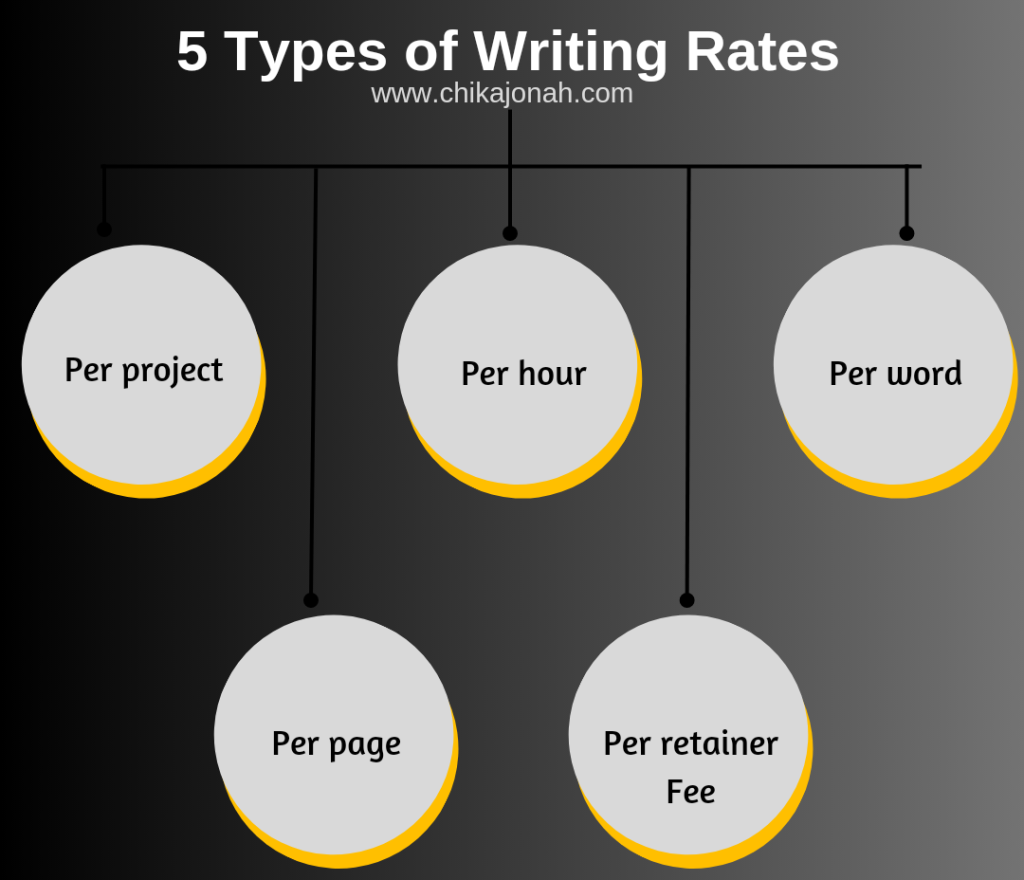
    5 types of writing rates to aid in pricing your writing services.

    5 Types of Writing Rates. 

    Per project

    If you’re an expert in a specific type of assignment, project-based pricing is often the most lucrative option. It allows you to complete tasks efficiently while earning a handsome fee. Pricing your writing services per project helps you account for every resource you need to complete the project, thereby helping you figure out a suitable flat rate. 

    Per hour

    Hourly rates are suitable when a project demands a significant amount of time and effort. However, many clients are cautious about hourly billing, so you’ll need to demonstrate transparency and accountability in your time tracking. Personally, this is my least favorite type of rate so I tend to avoid hourly-paid projects because charging by the hour might put you at a disadvantage, especially if the project can be completed in just a few hours. 

    Per word

    Charging by the word is a fair and transparent way to price your writing services. Both clients and writers benefit as you’re compensated based on the actual content produced. However, be vigilant about how clients count words—whether it’s based on the final draft or the published version. Whenever possible, request that the client use a higher word count to ensure fairness.

    Per page 

    When pricing your writing services using page-based pricing, it’s crucial to define what constitutes a “page” up front. Specify the page size, font type, font size, character spacing, and line spacing (single, 1.5, or double). Once you and the client agree on these parameters, calculate the approximate word count per page. Then, multiply it by your current price per word to determine the page rate.

    Per retainer fee

    Retainer fees are an excellent option for long-term clients. I use this for my returning clients a lot. However, it’s essential to establish a clear understanding of the monthly workload in advance when pricing your writing services with this method. For instance, if you charge $400 per month for four blog posts, clarify the word count per post. Any additional words or extra work should be outlined in advance to prevent misunderstandings and disputes.

    Factors needed in pricing your writing services
    Pricing your services well

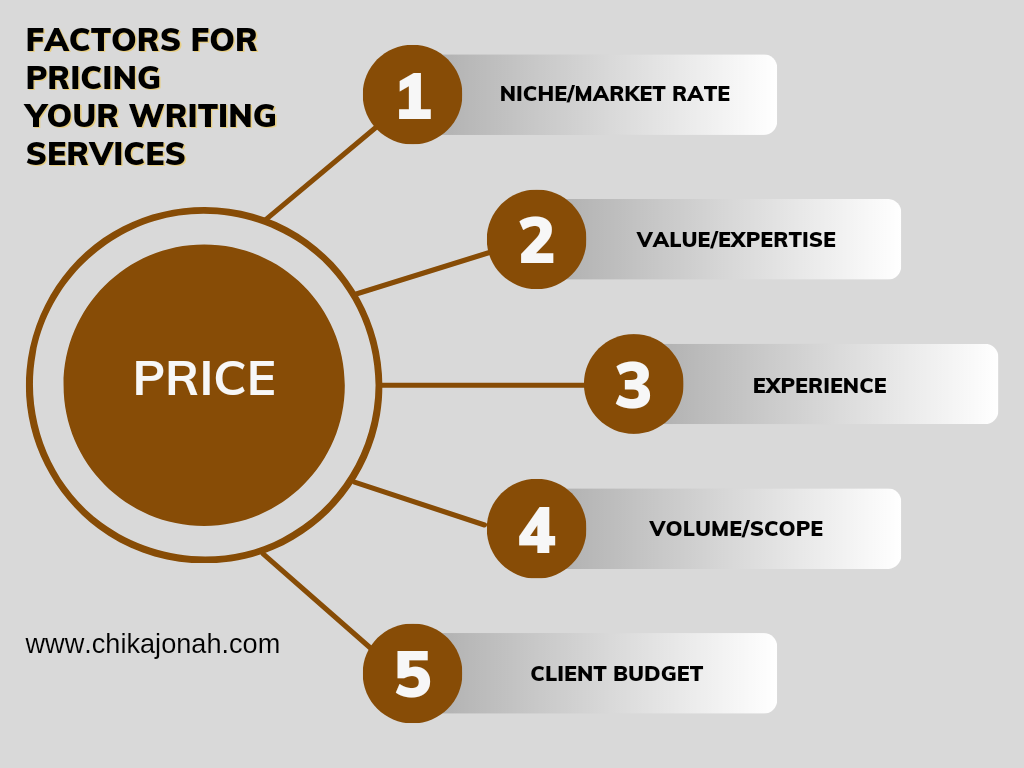
    5 Factors Needed In Pricing Your Writing Services. 

    A lot of writers struggle with how to price their work. Either they charge less or they can’t confidently state their price.  Pricing your writing services and setting the best rates for your work is a combination of these five (5) factors. They are: 

    1.  Niche

    2. Expertise

    3. Experience

    4. Scope/Volume

    5. Client profile 

    1. Niche/Market Rate 

    This is the industry standard for every niche. The price for a social media copy is different from the price for a blog SEO copy. The price for a tech blog content is different from the price for a business writing. The price for writing a web page copy is different from the price for writing a digital campaign copy. Search on Google to see the industry price for a particular niche and take note of it. 

    2.  Value/Expertise

    There is no shame in saying you know nothing much about something. Charge based on what you know. A writer who knows how to not only write SEO content but also the technical SEO for your site will charge more than you who only know how to write an SEO blog post. A writer who not only knows how to write but knows how to use storytelling to drive a narrative will charge higher than someone who simply knows how to write well.  So charge based on the level of your expertise.

    3.  Experience

    Have you ever wondered why brands hire based on experience? Because whether you choose to believe it or not, EXPERIENCE IS GOLD. This is why I advise writers to gain experience, even if it’s an unpaid job to build their portfolio. It doesn’t matter how well you write, an experienced writer is a seasoned writer. He/she has worked through different situations, styles, and conditions to produce results through their work. So it’s right that a person with more experience will charge more than you who have little to no experience. Set your price based on your experience  

    4. Volume/Scope

    The bigger the work the higher the price. A person writing a 400-page book should charge higher than a person writing a 100-page book. A 1000-word SEO blog post is less in price than a 2000-word SEO blog post. Additionally, a person writing a 7000-word research paper in ten days will charge more than someone doing the same work in one month because the time frame and scope are bigger. Charge based on the volume and scope of the work. 

    5. Client Budget/Profile

    Check if the client can pay you. Check their company. Check their location. Answer questions like; Is it a startup? Is it an individual? Is it a Nigerian or International company? It’s important to understand your client’s budget and their expectations. Ensure your pricing aligns with their financial constraints.

    Now that you know the factors that aid in pricing your writing services right, I’m sure your next question is how these factors play in fixing the best rates for your writing services. Well, sit tight, you are about to be blown away.

    The Undisputed formula to pricing your writing services

    The Formula to Pricing Your Writing Services. 

    Now you know that you need the Market rate, Expertise, Experience, Scope/Volume, and Client budget to price your writing. But note that these points do not work individually. 

    You cannot price your work just because the industry says that this is the amount to be charged per hour in that niche. You also cannot price your work ridiculously high just because the client or company has a huge budget and can afford to pay anything. 

    To price confidently, you’ve got to combine industry price, your expertise, your experience, the scope & volume of the work, and the client profile to set a fair price. Then add your expenses and tax. 

    Calculate Your Costs:

    1. Factor in your operational costs, including software subscriptions, research tools, internet connection, office space, and any other tools or resources you need for your writing.

    2. Also account for taxes and other financial obligations.

    In pricing your writing services, balancing these factors together and being confident in your skills and in communicating the value you bring to your clients is essential. Over time, as you gain experience and build a reputation, you can adjust your rates accordingly.

    Also, don’t hesitate to ask your senior colleagues in the industry to assist you when you’re conflicted on how to charge for a particular work. Their experience and guidance would be an added advantage to you. You can contact me anytime here 

    Ready to price your writing services

    Ready to Price

    While it’s important to price right, it’s also important to emphasize the value you bring to the client. How will your writing benefit their business or project? Use this as a selling point when discussing your rates. 

    Before you discuss rates and pricing, discuss value first. It shows that you care about the brand and you take pride in the work you do. This would also make the client believe in your capabilities and pay you accordingly. 

    Remember that pricing your writing services can vary widely depending on the industry, location, and individual circumstances. It’s crucial to be transparent with clients about your rates and the services they include. Additionally, as your skills and portfolio grow, you can consider adjusting your rates to reflect your increasing value in the market. Even if you’ve failed once at charging your worth, don’t stress, follow this formula and set the best price for your services. I hope this content has opened your eyes to pricing your writing services the best way. 

    Was this useful? Let me know in the comment below.